

Gateway to the Earth's Depths: An Industrial Explorer's Route to the Kola Superdeep Borehole and the Secrets of Zapolyarny
An honest guide to visiting the legendary Kola Superdeep Borehole (SG-3): the history of the 12,262-meter world record, the current state of the site, travel logistics, and safety guidelines.
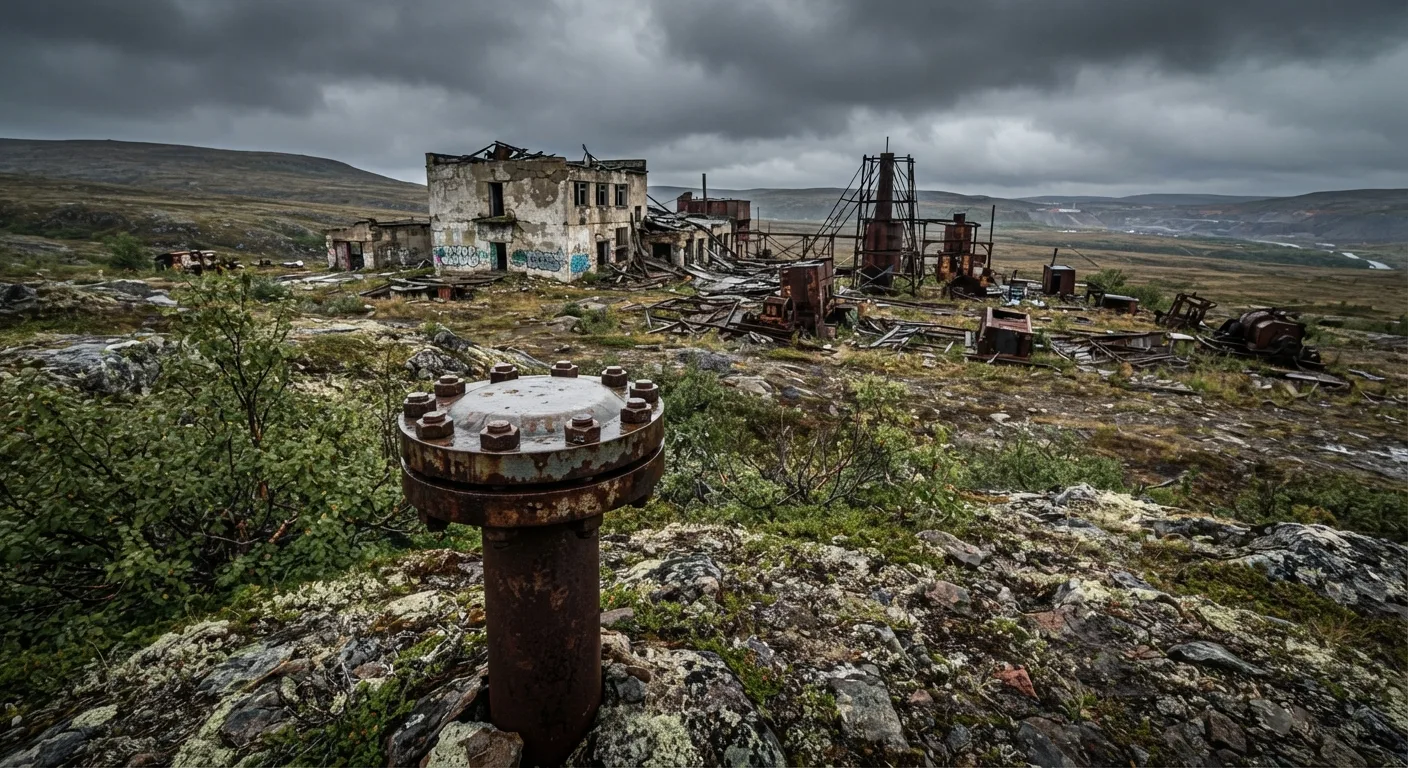
Among the rocky hills of the Pechengsky District, not far from the border with Norway, lies a site whose name resonated across the global scientific community in the second half of the 20th century. The Kola Experimental Basic Superdeep Borehole (SG-3) is a monument to the incredible engineering audacity of the Soviet era. It was here that humankind reached deeper into the planet’s crust than anywhere else on Earth. Today, SG-3 is an iconic destination for fans of industrial tourism and urbex aesthetics. This journey is not about polished luxury; it is about the pulse of genuine history, the harsh Arctic tundra, and the grand scale of human ambition.
The Triumph of Science and the Birth of Urban Legends
Drilling of the borehole began in May 1970 to mark the centenary of V. I. Lenin's birth. The primary goal of the project was not mineral extraction, but fundamental geological and geophysical research: scientists wanted to directly study the composition of the Earth's crust at depths previously accessible only via seismic waves.
In 1989, the drill reached a depth of 12,262 meters. This record for vertical penetration into the Earth's crust remains unbroken and is registered in the Guinness World Records. Over two decades of drilling, scientists made dozens of fundamental discoveries:
- Disproved the classical two-layer model of the continental crust: no boundary transition to basalt was found at the predicted depth; instead, only the physical properties of the granites changed.
- Discovered the circulation of mineralized aqueous solutions at immense depths exceeding 7–9 kilometers, where rock had previously been assumed to be completely solid and dry.
- Recorded the presence of fossilized micro-organisms in rocks nearly 3 billion years old.
- Encountered anomalously high temperatures: at a depth of 12 kilometers, the temperature exceeded 220 degrees Celsius, which significantly hindered further work and led to frequent drill string breakages.
These technical difficulties and the colossal pressure gave rise to the famous "Well to Hell" urban legend. In the late 1990s, foreign and domestic media circulated a myth claiming that Soviet scientists had lowered a heat-resistant microphone into the borehole and recorded the screams of the damned. For any geologist or local resident, this story is nothing more than amusing folklore: lowering sound recording equipment to such depths is physically impossible due to the extreme heat and pressure, and the circulating recording was simply spliced together from movie sound effects.
What SG-3 Looks Like Today
Following the termination of drilling and mothballing of the project in the 1990s, the facility gradually fell into ruin. In the 2000s, the famous 68-meter derrick and metal structures were dismantled. Today, the area resembles a set from a post-apocalyptic film.
The borehole itself is not a gaping black abyss as one might imagine, but a massive steel cap welded and bolted to a pipe flange just over 20 centimeters in diameter. On the cap, enthusiasts and travelers regularly repaint the historic figures: "12,262 m". Around it stand crumbling reinforced-concrete hulls of laboratories, compressor stations, and administrative buildings with shattered windows, peeling plaster, and discarded fragments of decades-old documentation.
An Industrial Outpost: The Town of Zapolyarny
The route to the borehole passes through Zapolyarny, a company town established in the late 1950s around a copper-nickel deposit. Here, the powerful rhythm of northern industry is immediately palpable. The surrounding landscape is dominated by the processing facilities of the Kola MMC, slag heaps, and endless hills carpeted with reindeer lichen and dwarf birch.
Zapolyarny is worth a brief stop: check out the local history museum (operating hours permitting), which carefully preserves authentic core samples—cylindrical rock columns extracted from multi-kilometer depths of SG-3. In town, you can also restock drinking water, grab a bite to eat, and refuel your vehicle before turning onto the dirt road.
How to Get There from Murmansk: Logistics and Border Zone
The distance from Murmansk to Zapolyarny is approximately 160 kilometers along the R-21 "Kola" federal highway toward the state border with Norway. The road is paved and well-maintained, offering majestic views of the Valley of Glory and the Zapadnaya Litsa River. The drive takes around 2.5 hours.
Important Nuance: Border Control
At kilometer 100 of the highway, near the Titovka River, there is a permanent border checkpoint. Russian citizens traveling toward Zapolyarny and Pechenga need only carry an original Russian internal passport (or birth certificate for children). Document checks are selective but mandatory. Foreign citizens require a special border zone permit arranged well in advance through the FSB border service to enter this area.
The Final Kilometers of the Journey
From Zapolyarny, about 12 kilometers remain to the ruins of SG-3. After leaving the asphalt, you transition onto an unpaved industrial access road. Its condition varies greatly depending on the season: it is strewn with sharp rocks, potholes, and washouts. An ordinary city sedan can only manage the drive with extreme caution in dry weather, carrying a high risk of scraping the rocker panels or oil pan. The optimal vehicle is a crossover or 4WD SUV with rugged tires and high ground clearance.
Seasonality: Choosing the Right Time
When planning an expedition to the Kola Superdeep Borehole, keep in mind the demanding climatic calendar of the polar latitudes:
- Summer and early autumn (late June to late September) — the ideal window for a visit. The road is clear of snow, the tundra dons green and crimson hues, and there is no danger of getting stuck in snowdrifts. In July, the sun never sets below the horizon thanks to the polar day.
- Shoulder season (May to early June, October) — the muddy season (rasputitsa). The dirt road can be heavily washed out by meltwater, dense fog frequently cloaks the hills, and temperatures drop sharply. A well-equipped 4x4 is essential.
- Winter (November to late April) — a challenge for experienced adventurers. The track to the borehole is not cleared by snowplows. Reaching the site is feasible only by snowmobile or on skis/snowshoes from the highway. An added factor is the polar night from December 2 to January 11, when daylight is completely absent and freezing cold is accompanied by gale-force winds.
Safety Guidelines for Industrial Explorers on Site
The ruins of SG-3 are in a hazardous state, so casual sightseeing carelessness is unacceptable here. Observe basic safety precautions:
- Clothing and footwear: even in summer, follow the three-layer rule (moisture-wicking thermal base layer, insulating fleece, and a wind- and waterproof shell jacket). On your feet, wear only sturdy high-top trekking boots with rigid soles. Inside and around the workshop ruins, there is abundant broken glass, protruding rusted rebar, and jagged metal scrap.
- Caution under roofs: reinforced concrete slabs have lost structural integrity after decades of exposure to frost and moisture. Do not stand under overhanging slabs, avoid climbing unstable staircases without railings, and watch your footing closely—the site contains industrial manholes and open pits several meters deep.
- Connectivity and self-reliance: mobile phone reception at the former SG-3 site is patchy and drops out completely in places. Be sure to inform loved ones of your route, and carry a power bank, a headlamp, and a basic first-aid kit.
A trip to the Kola Superdeep leaves an indelible impression: here, one feels keenly the frontier between the grandeur of human engineering achievement and the silent power of northern nature reclaiming its domain.
After an eventful day amidst the tundra winds and the industrial scenery of Zapolyarny, returning to warmth and comfort is especially gratifying. 69 Parallel Hotel in Murmansk (14 Lyzhny Proezd), with its 24-hour front desk, private parking, and hearty breakfasts, will serve as a comfortable and reliable base for your expeditions across the Kola Peninsula.